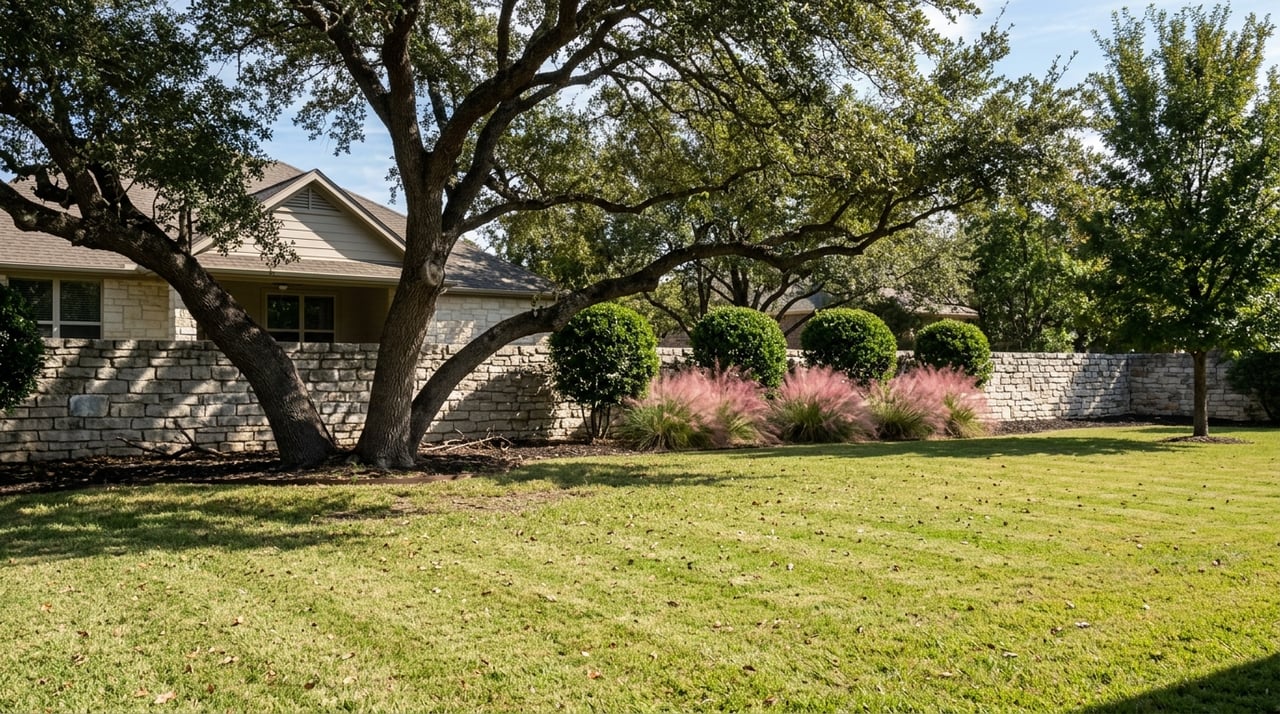
A homeowner in Flower Mound calls a contractor about a fifteen-foot bump-out on the back of the house. The contractor pulls a building permit, checks setbacks, confirms the foundation plan. The town's Environmental Services division may also ask whether the post oak at the back corner of the lot has been surveyed.
Tree-related reviews and permits may affect a project's timeline and cost. Flower Mound has a tree-permitting process alongside its building permit process, with requirements based on the trees on the lot.
How tree permits fit into a project
Flower Mound's Code of Ordinances, Chapter 94, treats certain trees as protected regardless of what a property owner wants to build. Under Section 94-34, any tree on the town's protected list that measures more than six inches in diameter, measured at four and a half feet off the ground, requires a removal permit if it sits outside the actual buildable footprint of the house. The threshold can apply to ordinary trees in areas planned for a driveway extension, a pool, or a side yard addition.
This means the tree permit conversation often starts before the building permit does, not after.
Not every tree is treated the same way
The ordinance sorts trees into tiers, and each tier changes what you owe and how long the process takes.
Tier | What triggers it | Survey required | Removal penalty if unauthorized |
|---|---|---|---|
Protected | Over 6 inches diameter, on the town's protected species list | Plot plan (under 1 acre) or certified arborist survey (1 acre+) | Replace at 5x caliper inches removed, or $250 per caliper inch |
Specimen | Meets size or species criteria set by the town, includes post oaks at 22 inches caliper and above | Certified arborist survey required regardless of lot size | Replace at 10x caliper inches removed, or $500 per caliper inch |
Historic/Majestic | Designated individually by the town for age or significance | Certified arborist survey required | Replace at 15x caliper inches removed, or $750 per caliper inch |
The 22-inch caliper line for post oaks is not arbitrary. It came out of a 2016 town council debate that the Cross Timbers Gazette covered in detail. Builders had pushed for a higher threshold, arguing that a lower one would double the number of trees classified as specimen and drive up mitigation costs on every lot they touched. The council settled on 22 inches as a compromise after considering those concerns.
How tree-removal penalties are calculated
For example: A post oak at the minimum specimen threshold, 22 inches of caliper, removed without a permit, carries a penalty of $500 per caliper inch. That's $11,000 in fines alone, separate from the mandatory replacement obligation of ten times the caliper inches removed, which means planting the equivalent of 220 inches of new trees on the same lot. If that same tree had been designated historic, the math moves to $750 per caliper inch and a 15x replacement requirement, pushing the fine past $16,000.
Tree-removal penalties are calculated per caliper inch, so the amount can increase with the size of the tree.
The reason the penalty is structured this way traces back to the tree itself. Post oaks are the species that define the Eastern Cross Timbers, the eco-region Flower Mound sits inside. They grow slowly, adding roughly one inch of caliper every seven years, and they can live for centuries. A 22-inch post oak has likely been standing since before the town incorporated. No replacement schedule, no matter how generous the multiplier, actually restores what was removed. The ordinance's penalty structure reflects that fact more than it reflects the value of lumber or landscaping.
The paperwork changes with the size of the lot
Lot size determines how much homework is required before a shovel touches the ground. According to Flower Mound's Residential Builders Packet, on a lot smaller than one acre, a plot plan showing tree diameter, canopy extent, and location relative to the building pad is enough. At one acre and above, the town requires a full tree survey prepared by a certified arborist or a registered landscape architect, and every protected tree over six inches has to be documented on it.
This matters more in Flower Mound than in a lot of DFW suburbs because larger, wooded lots are part of what the town markets itself on. A buyer comparing a half-acre lot in one section of town against a 1.2-acre lot two streets over isn't just comparing yard space. They're comparing which one requires a paid arborist survey before permits move forward.
Tree-removal permit timing
Even when a homeowner knows a specimen or historic tree removal is coming, the timeline isn't instant. The town's Environmental Conservation Commission meets on the first Tuesday of each month, and a tree removal permit application has to be submitted 30 days ahead of that hearing. A required notification sign, which costs $200 per sign and is produced by the town itself, must be posted on the property at least 15 days before the hearing date.
Taken together, those steps can add six to eight weeks before construction begins. Homeowners planning around a school year or listing date can account for that time in their schedules.
During construction, protected trees require fencing at the drip line to keep grading and equipment away from the root zone, and specimen or historic trees carry a stricter standard: six-foot chain-link fencing around the drip line specifically. That fencing has to stay up for the duration of the project, not just during the initial site work.
What this means before you buy, build, or list
For a buyer evaluating a lot with mature trees, the practical move is to ask for a tree survey, or commission one, before finalizing a floor plan that assumes a certain footprint. A driveway or addition that looks straightforward on a site plan can shrink once a specimen tree's drip line is mapped out.
For a seller with a specimen or historic tree on the property, disclosing what's already on record with the town helps a buyer plan for tree-related requirements before renovating, and it can be a selling point rather than a liability. A documented, healthy post oak is part of what gives an established Flower Mound lot its character, and buyers who understand the ordinance often see it as an asset rather than an obstacle.
For anyone planning a teardown-rebuild or a major addition, this is precisely where a construction-minded perspective earns its keep. Reading a tree survey the same way you'd read a foundation report, understanding which trees are load-bearing to the site plan and which ones simply need a straightforward removal permit, helps account for tree-related timing in the project schedule.
A few questions worth asking early
Does a simple deck or patio addition trigger a tree survey? It depends on the project.
Can I pay a fee instead of planting replacement trees? According to Tree Renewal, a property owner can, with approval, pay into the Reforestation Fund instead of planting replacements on site.
Flower Mound's tree ordinance is worth considering as part of the transaction from day one, alongside other permitting considerations. Mellissa and Leo built Go To Texas Team around exactly this kind of dual read, matching relocation and transaction guidance with a construction-trained eye for what a property can actually support. If you're weighing a lot, a renovation, or a listing in Flower Mound and want a clear-eyed look at what's overhead as well as what's on the market, reach out to Go To Texas Team to talk through your specific property before you make a move.
This article is general information, not legal, tax or financial advice. Consult a qualified professional about your situation.